Monday, August 12, 2013

A Modest Proposal: Quakers Should Embrace Multiple Views of Christ’s Atonement


ESR's Stephen W. Angell shares this reflection after attending Indiana and Ohio Valley Yearly Meetings this past summer:

The most constructive theological move that Quakers could ever make is cheerfully to agree to disagree on the Atonement. Not on the fact of the atonement itself.  From the seventeenth century onwards, Quakers have properly held that the influence of Christ Jesus who died and rose again at Jerusalem 2000 years ago, and the continuing influence of the Light of Christ Jesus within us, are that in which we place our hopes and in which we rest in confidence of salvation. No, we need to be able to see reason in wide-ranging views on how exactly Christ Jesus accomplishes that atonement on our behalf. The Christian Churches as a whole have never been able to agree on the latter question, whether at the seven Ecumenical Councils prior to 787 or at any other time. Why should Quakers think that we should be able to succeed in prescribing a single view, where other Christians have failed? The sole result has been endless rounds of separations, splits, and schisms. If we could agree that varying views of the atonement are compatible, and be able to embrace many such views and be highly reluctant to exclude any, we would be far ahead of where we have been for the past 200 years.
Quakers, and Christians, are besieged on all sides. Some of the battering that Quakers in the Midwest have experienced over the past few decades has been social and economic. Several Friends at the latest sessions of Indiana Yearly Meeting (a yearly meeting of mostly evangelical Friends), including plenary speaker Ron Selleck and Van Wert Friends pastor Paul Hamrick, have given persuasive accounts of the human devastation that has resulted from the closing down of factories and the waning of family farms. Both Selleck and Hamrick discussed their ministry to people with addictions and mental illness, exacerbated, one would think, by the region’s economic decline. What these down-and-out folks require is a Savior with power, one who is able to take away their sins and to bear their punishments. On this Savior who atones vicariously (in our place) for our sins, we can lean completely and with confidence. This is the first step for these folks – let’s call them new Friends – to begin to turn around their lives. We need this powerful Savior, this Lord, who demands our obedience, and who atones for our sins in place of us!
But that is only one of the challenges that Christians – and Quakers – have faced. Another is with a highly educated elite on college and university campuses. These folk have great confidence in the power of reason, and they sometimes are put off by a religion like Christianity that celebrates the “foolishness of God [which] is wiser than men.” Friedrich Schleiermacher, an early advocate of liberal theology over two centuries ago, knew this type of skeptical audience very well, and addressed his speeches on Christianity to the “cultured despisers” of religion. 


Yet this group also may be attracted by the Good News of a Christ that is our friend, one who walks and talks with us, and serves as an example for us. This is the Christ who leads us through our spiritual journey, our religious experience. This Christ Jesus is a rabbi, a teacher; and the Light of Christ Jesus that continues within us is our Inward Teacher. At Ohio Valley Yearly Meeting (a yearly meeting of mostly liberal Friends), which met the weekend after Indiana Yearly Meeting, this friendly savior Christ was very highly regarded and spoken of.
The truth, of course, is that the Christ who speaks to drug addicts and the mentally ill and the Christ who speaks to educated elites is the same Christ. The Christ who lived two millennia ago and the Christ who continues to live in our hearts is big enough to embrace all of these attributes that Christians have so impressively testified to. Sometimes, however, we want to narrow Christ down. At both Ohio Valley and Indiana Yearly Meeting, I heard voices of disapproval toward the view of Christ and Christ’s atonement that was not the featured one at that yearly meeting’s session. One speaker at Indiana Yearly Meeting stated that the fact that “Jesus was a good teacher and charismatic rabbi is important, but not enough.” The only Jesus powerful to save people deep in sin, such as people suffering from addictions, is a Jesus that has been crucified and resurrected, who has suffered for our sins in our place, despite the fact that none of us deserve it. Expressions at Ohio Valley Yearly Meeting were more fleeting, but at times there was expressed a clear preference for the model of Jesus as a friend, as the human savior who leads in the paths of the Quaker testimonies – peace, equality, simplicity, and integrity, and sometimes it may have been implied that other models of the atonement do not measure up.
This is, of course, not the first time that Quakers have taken sides on the issue of the atonement, and the results have sometimes been disastrous. Two centuries ago, Elias Hicks decried those who believed that Jesus’ blood was saving, stating that Jesus’ blood was no more instrumental in our salvation than the blood of a chicken. Orthodox Friends such as Thomas Evans and Joseph John Gurney responded with numerous assertions that the blood of Jesus was saving to all humanity, together with many Scripture passages to support their assertions. The result was a wrenching separation, which affects the Society of Friends adversely to this day.

Friends would be better off, if we would state our views of the atonement positively, and view what others say about the atonement generously. The truth is that, Quakers and Christians, besieged by pressing problems and issues on all sides, should have more important things to do than engaging in polemics on Christ’s atonement. The social problems identified above can be overlapping ones, but you don’t have to be a university professor with a drug addiction problem, or an unemployed auto worker who likes to read philosophy and is skeptical of traditional theological explanations, to appreciate how the theories of the atonement delineated above ought to be complementary. Jesus Christ is both Inward Teacher and Lord. Jesus saves, because he comes with power, and Jesus is our friend. Jesus takes our punishment and suffers on our behalf on the cross, and Jesus is alongside us as companion and within us as Light and always available as a counselor. Let us embrace a Quakerism and Christianity where we embrace all friends (and Friends) on a common meeting ground.


Steve Angell is the Professor of Quaker Studies at ESR

Wednesday, August 7, 2013

From Dust to Dust

The following is drawn from a message delivered during worship at Richmond First Friends on August 4 by Matt Hisrich:


They heard the sound of the Lord God walking in the garden at the time of the evening breeze, and the man and his wife hid themselves from the presence of the Lord God among the trees of the garden. But the Lord God called to the man, and said to him, ‘Where are you?’ He said, ‘I heard the sound of you in the garden, and I was afraid, because I was naked; and I hid myself.’ He said, ‘Who told you that you were naked? Have you eaten from the tree of which I commanded you not to eat?’ The man said, ‘The woman whom you gave to be with me, she gave me fruit from the tree, and I ate.’ Then the Lord God said to the woman, ‘What is this that you have done?’ The woman said, ‘The serpent tricked me, and I ate.’ The Lord God said to the serpent, ‘Because you have done this, cursed are you among all animals and among all wild creatures; upon your belly you shall go, and dust you shall eat all the days of your life.  I will put enmity between you and the woman, and between your offspring and hers; he will strike your head, and you will strike his heel.’ To the woman he said, ‘I will greatly increase your pangs in childbearing; in pain you shall bring forth children, yet your desire shall be for your husband, and he shall rule over you.’ And to the man he said, ‘Because you have listened to the voice of your wife, and have eaten of the tree about which I commanded you, “You shall not eat of it”, cursed is the ground because of you; in toil you shall eat of it all the days of your life; thorns and thistles it shall bring forth for you; and you shall eat the plants of the field. By the sweat of your face you shall eat bread until you return to the ground, for out of it you were taken; you are dust, and to dust you shall return.’
Genesis 3:8-19


Have you ever seen the movie “Matchstick Men”? It stars Nicholas Cage as a con man with a unique personality quirk – he’s an obsessive compulsive cleaner.

To dramatically illustrate this, at one point during the film, there is an extensive montage scene of him performing a thorough cleaning of every square inch of his home. The camera zooms in on him as he lies on his back carefully dusting beneath his living room table with a rag and cleaner. 

It’s a convincing performance. And I have to confess to you that I secretly envied him while watching him there on his back.

You see, while I don’t mean to treat mental disorders lightly, part of me really wishes I could be that obsessed with cleanliness. As I sat there watching his absurd devotion to this perfection I couldn’t help but think, “Oh, if I only had the time and energy. Wouldn’t it just be great to live in such an impeccable home?!?”

Part of this desire is the recognition that I simply do not live up to this standard – by any stretch of the imagination. Anyone who has visited our home knows that it is a chaos of children and pets and laundry and dishes.

This felt absence of achieving a standard drives a subconscious sense that if I only could all would be well. I would be satisfied and whole.

The flip side of this, of course, is my continual failure to succeed means that I can never truly feel satisfied and whole. All is not well because I simply cannot arrive at this level of purity and perfection. And we’re not talking about the whole world here, but just the small space of my own home.

I have waged mini-wars against dust, but I always lose. Changing furnace filters, cleaning ducts, washing fans, vacuuming, wiping down walls and window sills…nothing ever seems to end the cycle.

Worse, at a deeper level there is the real disappointment that it’s not just me. Even Nicholas Cage and his dust rag can’t keep something perfectly clean forever. A well-cleaned home today will need to be cleaned again tomorrow.

This is due to a fact of life – dust is everywhere, unavoidable. Have you ever paused for a moment to look at a sunbeam shining through a window? What do you notice?

The air all around you isn’t just oxygen. There’s a glittering, swirling mass of visible particles floating all around us that we don’t even notice or think about until it stares us right in the face.


And I know I add to the problem with my nasty human habit of constantly shedding skin and hair particles. Just like that house, no matter how long I spend in the shower today, I’ll still need one tomorrow.

You shed dust, you are dust, and to dust you shall return.

This is the reality of our human condition. I think that’s perhaps why it’s such a foundational part of the narrative of humanity we find in Genesis. And I think that this very intimate and personal cycle of creation, consumption, and dissolution that connects us to all others and the world in its wholeness, its past and its future, is described here in this passage at this moment in this text for a reason.

This break with God’s will, this action or failure to act WELL, is tied here to our birth, and life, and death, and it applies to us all.

Yes, I’m talking about the “s” word – sin. I’ll just come out and say it. Like dust, it exists all around us close to home and far away. And we participate in it, and it is in us, personally, corporately, globally, from the sneer and the turning aside to the torture and the distant bomb dropped in our names.

The fact is that no matter how hard we try, you and I cannot extricate ourselves completely from this all-encompassing, all-pervasive reality.

And yet, and yet, while not discounting or dismissing this reality, I believe Scripture does not make it the focal point. In fact, quite the opposite.

Let’s take a moment and reflect on this. To whom does Jesus reserve his harshest rebukes, for example?  For the most religious members of the community. Why is this?

Why would he call them whitewashed sepulchers?  Why would he tell us to hide our prayers rather than say them in public?

Why does Paul carry this forward with lengthy arguments against law over faith in letter after letter?

I think at least part of the answer has to be that they recognized that a desire for purity and perfection can consume you.

It’s an impossible standard – Paul in Romans, all have sinned and fallen short of the glory of God.

An argument can be made that this is one of, if not THE central theme of the New Testament. 


In the book Viral, George Fox University professor Leonard Sweet explains it like this: “Christianity is a wabi-sabi religion.

“Wabi-sabi is the Japanese tradition of celebrating the beauty in what’s flawed or worn, decrepit or commonplace. I call it the art of imperfect beauty. Wabi-sabi offers an inspiring new way to look at your home, your life, your ministry, your church…”

“To discover wabi-sabi,” says Sweet, “is to understand God’s hallowing of hollowed-out, broken people to bless a harried world. Wabi-sabi understands the singular beauty of wetlands, the raw richness of repentance, the tender acceptance of another day lived with all its marvels and mistakes.”

“A wabi-sabi home does not confuse godliness with cleanliness and is at peace with the dirt of its surroundings.”

“Christianity is a wabi-sabi religion.”

In contrast, an overly zealous pursuit of cleanliness – moral or otherwise – can turn a person into a moral monster, robbing both themselves and others of peace and blessing and grace.

One that scolds another for bringing healing at the wrong time or the wrong place, for spending time in the wrong places with the wrong people, for neglecting “holy” purity in order step off the road and into the gutter to pick up and care for a wounded stranger. One that, for whatever good reason, confuses following the letter of the law with its spirit.

So I don’t think Scripture gives us an image of humanity absent a tremendous capacity for evil, but I also don’t think it denies us the opportunity to be a part of its tremendous capacity for good.

Jesus doesn’t deny the sin of adultery, he just says to go and do it no more. And where the overwhelming weight of our own and the world’s sin could lead us to despair, bitterness, rage, or paralysis, Paul says “No, you no longer have to be consumed by obedience and disobedience to the law.

“Instead, strive toward the finish and the fullness of Christ. Run the good race in spite of the thorns in your flesh.”

To me this means two steps - first acknowledging the reality of sin – its hold on us, and our embeddeness and participation in it.

But then it also means not letting that sin be our master – to strive but not be overcome. To hold onto that reality, but to hold it lightly.

This leads to a potentially profound turn. I think it may be part of what Jesus and Paul tried so desperately to get across.

When we take seriously both the reality of our place within sin as well as our freedom from its choking hold, this places us in a very different relation to those around us, those whom we might be tempted to judge or scorn.

We can be humble before God and before our neighbor. We can be broken people blessing a harried world.

When we make this move, we can finally let go of the rocks we hold so tightly in our hands…and let them fall away like so much dust.


Matt Hisrich is a graduate of ESR and serves as the School's Director of Recruitment and Admissions.

Monday, July 29, 2013

Report on the 6th International Conference on Conflict Resolution Education


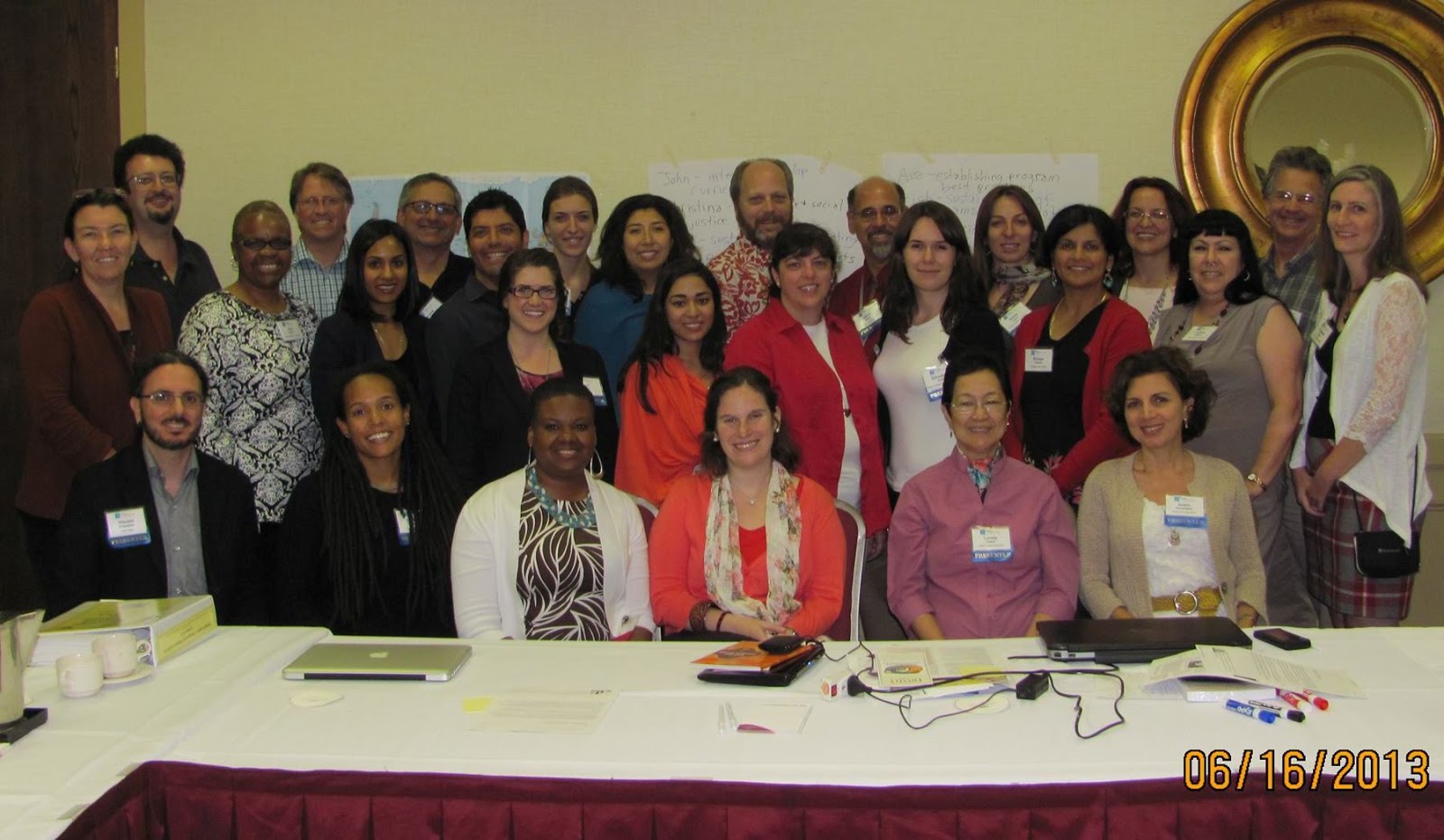
ESR Professor of Peace and Justice Studies Lonnie Valentine brings us this report from the 6th International Conference on Conflict Resolution Education, held June 12 – 17, 2013 in Cleveland, Ohio:


(Picture from an intensive 2 day working group meeting of colleges and universities developing peace and conflict studies programs from 4 year and 2 year institutions as well as many organizations that work in education.)

As we watch our country turn against own citizens as it has turned on millions around the world, it is easy to get discouraged.  The Trayvon Martin murder by a troubled stalker with state sanction to murder is an apt metaphor for our descent.  Zimmerman holds up a mirror to what we have become. We are encouraged to be each others deadly enemies with the support of our own government and its corporate sponsors. 

However, though these events can lead to despair and frustrated anger, I had the opportunity to spend six days immersed in a conference with peace educators from around the world.  At the Sixth Annual Conference on Conflict Resolution Education, there were over 200 participants from some 21 countries there, sharing both the struggles and successes of their work.  Also, there were representatives from colleges, governments, intergovernmental organizations, and multinational non-governmental organizations.  Yes, to hear of what others face in dealing with the violence in their countries was hard, but hearing these stories struck me as a way to of qualifying my sense of American “exceptionalism”  That is, my despair that the United States Empire is the greatest purveyor of sickening violence around the world was strangely relieved is seeing that we are not alone. 

However, most encouraging was seeing the fortitude and commitment of individuals and their organizations hanging in there to offer another way of addressing violence.  These people and their stories were inspiring.  Here are but a few examples:
            - a young woman from El Salvador working with street gangs

            - a former staff of the US Institute of Peace presenting research on how many US community colleges are developing peace studies programs

            - a teacher working with students at his school tin Appalachia develop a “Peace Club” which to his surprise was meeting a great need he did not know was there

            - community college students leading a program called Sustained Dialogues to address the great racial, class and ethnic diversity at their campus

            - two young people from the Balkans working to heal conflicts there and teach alternative dispute resolution to other young people form the region

            - social science research supporting the view that successful nonviolent resistance makes for stronger democracies that are less likely then to descend into civil war

            - seeing what the US Institute of Peace is providing for middle and high school teachers on peace education

            - how the Organizationof American States is working to promote more student exchanges in the Americas

The highlight of the conference for me was working with ESR graduate Silas Wanjala for our workshop presentation on the Alternatives toViolence programs in Kenya.  It was great to see Silas again and see him connect with other peacemakers from Africa.  To see what he is doing--as with other ESR grads in their ministries--is the most encouraging aspect of my teaching. You can read more about Silas's work here.

I have collected many resources from this conference, and would be happy to send you electronic resources and links to organizations.  For a fine overview of what went on and resources you might find of use, check out the Facebook page for this conference:  www.facebook.com/international.cre.conference13

Friday, July 12, 2013

Calling all Quaker College Students!

Elton Trueblood once said that "No fires burn unless someone gathers the sticks and does the enkindling, as well as the replenishing." In that spirit, Earlham School of Religion invites Quaker college students from across the country to join us for the second annual Quaker College Leadership Gathering this August 14-15, 2014 in Richmond, Indiana.


ESR planned this event in coordination with Quaker program leadership from George Fox University and Earlham, Guilford, Haverford, and Wilmington Colleges. You will have the chance to meet peers from these and other schools and discuss how they live out their faith and how they get their message out to their communities. 

Following the Gathering, you will have the opportunity to stay for ESR’s annual Leadership Conference August 15-17 to participate in intergenerational dialogue around servant leadership and listen as representatives from a host of Friends organizations and others share from their experience.

A registration fee of only $50 covers:

- Quaker College Leadership Gathering attendance - including sessions, meals, and lodging
- Leadership Conference attendance - including sessions, meals and lodging

Registration is limited, so reserve your spot now! A limited number of travel scholarships are also still available. Don't miss this chance to start your next year of college off as part of a truly incendiary fellowship - a nationwide group of fire-starters!


Online registration is available here. For more information , please contact ESR Director of Recruitment and Admissions Matt Hisrich at hisrima@earlham.edu or (765) 983-1523.