I am currently
staying for a few months in a small town called Richmond in rural Indiana.
Unlike my neighborhood in Portland, OR, there is no Whole Foods here, no
organic kale, no unbleached toilet paper, no vegan deli, and few who could
afford these things if they were available. The local grocery store does a find
job, but they do not have the staff to rush to open a new cash register when
the line gets longer than two customers.
Monday, March 26, 2018
God in the Checkout Line
ESR MDiv student Keelin Anderson prepared the following essay for the Pacific Northwest Quaker Women's Theology Conference coming up June 6-10, 2018, in Canby Grove, Oregon:
Friday, March 23, 2018
Practicing Mysticism in the World
ESR Board of Advisors Clerk Dwight L. Wilson delivered the following message during ESR worship on Thursday, March 22, 2018:
![]() |
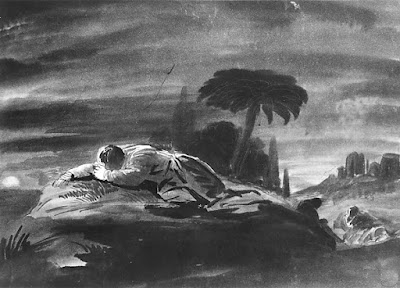
| Christ in the Garden of Gethsemane, Robert Walter Weir |
Jesus was my first hero. I expect him to also be my last. One of my favorite stories is of him in the Garden of Gethsemane praying, "If it's possible, remove this cup." We don't read the answer; it is implied. This is almost universally true in the Gospels. Jesus prays. By his actions we learn the answer.
I write modern psalms directed to the Holy One. I am a mystic who, like Jesus, receives my answers in organic surround sound. From the Spiritual Source I act out my response. This has been true since in nearby Middletown, Ohio I became both the first conscientious objector I had ever met and the first black protester I knew to take complaining to the streets. From the activation of spirituality I am happy to say I have photos of my three young grandchildren demonstrating separately at multiple sights in California and Kansas. One person is an aberration. A second generation is a trend. A third generation is a family tradition. As Jesus' brother said, "Faith without works is dead."
Monday, March 5, 2018
When God is calling
ESR MDiv student Keelin Anderson delivered the following message during ESR worship on Friday, March 2, 2018:
Luke 9: 1-6 NRSV
Then Jesus called the twelve together and gave them power and authority over all demons and to cure diseases, and he sent them out to proclaim the kingdom of God and to heal. He said to them, “Take nothing for your journey, no staff, nor bag, nor bread, nor money—not even an extra tunic. Whatever house you enter, stay there, and leave from there. Wherever they do not welcome you, as you are leaving that town shake the dust off your feet as a testimony against them.” They departed and went through the villages, bringing the good news and curing diseases everywhere.
Luke 9: 57-62 NRSVAs they were going along the road, someone said to him, “I will follow you wherever you go.” And Jesus said to him, “Foxes have holes, and birds of the air have nests; but the Son of Man has nowhere to lay his head.” To another he said, “Follow me.” But he said, “Lord, first let me go and bury my father.” But Jesus said to him, “Let the dead bury their own dead; but as for you, go and proclaim the kingdom of God.” Another said, “I will follow you, Lord; but let me first say farewell to those at my home.” Jesus said to him, “No one who puts a hand to the plow and looks back is fit for the kingdom of God.”
I joke here, but Jesus is saying his call is not an easy one. There will be people in your life who will not understand. There will be habits and assumptions of your own you will have to leave behind. God is calling for an ongoing radical transformation in your way of being in the world. Not everything and everyone in your life is going to come along with you.
Three years ago I was minding my own business, walking home from a yoga class in my neighborhood in Portland, OR, when an idea popped into my head. “Go find out what it takes to become a hospital chaplain,” it said. I had been a nurse and a massage therapist, so in a way this made sense, but I had never had a religion. I was raised by divorced parents, my mother a scientist and atheist, my father, a psychiatrist who during my teen years, lived in a cult that followed the Bhagwan Shree Rajneesh. Religion at the least was suspect, at the most, dangerous.
I had come to my own sense of God in my late twenties through meditation, a practice I mostly did by myself. It had never occurred to me to do religion with other people. My sense of religious people came from American media. Throughout the world people were fighting wars in religion’s name. At home, “Christian family values” meant homophobia and misogyny. As far as I could see, religious people wanted either to control me or kill me. Now God wanted me to get an MDiv?
And here I am three years later giving a sermon! I have not made a dime since I began school. I have abandoned my husband and two cats alone at home in Portland for this Spring Term. I have discovered I am a Quaker. I am learning to appreciate that there is something to this “gathering together in Jesus’s name.” I feel more able than ever to express my true self and allow God to move through me, and, I have to work constantly on my faith and courage.
Thursday, October 26, 2017
Jephthah’s daughter then and now
The other day, after grading a set of Intro to Old Testament Studies papers, I posted on Facebook, “It’s a good day when you learn new things about how to read well known texts from your students.” This post by ESR M.Div. Access student Nikki Holland is one of the papers I learned from. The assignment was to write about what you would say about one of the women from Joshua and Judges for an adult Bible Study group. Nikki chose to write on Jephthah’s daughter (Judges 11:29-40). I invite you to read what Nikki’s response. I hope you find it as illuminating as I did.
From the surface, the story in Judges 11:29-40 seems foreign and weird to us. A man makes a foolish vow and keeps it, though it results in the death of his daughter; and what is maybe more astonishing, she participates. But with a close examination of this story, we can see several themes that echo through our lives today.
- Nancy R. Bowen (Professor of Old Testament)
From the surface, the story in Judges 11:29-40 seems foreign and weird to us. A man makes a foolish vow and keeps it, though it results in the death of his daughter; and what is maybe more astonishing, she participates. But with a close examination of this story, we can see several themes that echo through our lives today.
1) Victim blaming
Upon realizing that he has vowed to
sacrifice his own daughter (hereafter called “Daughter”), Jephthah lays the
blame immediately on her head. “You have brought me very low,” he says. “You
have become the cause of great trouble to me” (Judges 11:35). He explains that
he has made a vow, but the emphasis is on her culpability. Never mind that he
made a foolish vow and she was simply fulfilling her role as a faithful
daughter in celebrating his victory.[1] Jephthah
deflects blame from himself onto Daughter. I hear echoes of his words in my own
generation, “Look what you made me do…” and “Well, you shouldn’t have been in
that place anyways."
Thursday, July 20, 2017
Preparing for war: Are we ready?
ESR Professor of Peace and Justice Studies Lonnie Valentine shares a reflection on the importance - and timeliness - of conscientious objection to war:
With the love of war growing strong, what will follow after
the attack on Syria, the “Mother of All Bombs” dropped on Afghanistan, and now
the threats directed at North Korea? As
with all previous war-making, this US administration sees how the people praise
war. Presidents going to war show
strength. Is it so that every US President must have his own war? Is our government now preparing to do what
Mark Anthony exclaims in Shakespeare's play Julius Caesar: “Cry
‘Havoc’ and let slip the dogs of war” (Act 3, Scene 1)? Unlike us, Mark Anthony was regretting that
this would be the cry heard as the Roman Empire descended into civil war. He says:
“Blood and destruction shall be so in use
And dreadful objects so familiar
That mothers shall but smile when they behold
Their infants quarter'd (i.e. cut to pieces) with the hands of war.”
And dreadful objects so familiar
That mothers shall but smile when they behold
Their infants quarter'd (i.e. cut to pieces) with the hands of war.”
![]() |
| Richard Burton and Elizabeth Taylor in Cleopatra |
And so it came to pass that Mark Anthony entered the Roman civil
war. However, he faced the one who would become Caesar Augustus. Anthony lost
the war and fled to Egypt with his queen, Cleopatra. Reaching the shore, they
committed suicide together.
![]() |
| Real child soldier, US Civil War |
And so what of those of us who seek a
better way? Many young people have been
drenched in war propaganda and think it could be grand. My spouse, Genevieve, is the piano
accompanist to a middle school choir. One girl was wearing a sash and Genevieve
asked what it meant. The girl replied,
“I am a diplomat. I and the other diplomats will gather to make war.” With
Genevieve's horror discussion ensued, but the young ones replied: “Peace is
boring; war is fun.”
Of the many things that we can do to prepare for war, here is one option for consideration: Quakers and others seeking peace and pursing it need to teach
our own young people about the option of conscientious objection to war.
Monday, June 19, 2017
New student introduction: Mebin Mathew
We are excited to begin introducing to you some of our incoming students for the fall 2017-18 entering class. Our first introduction is from Mebin Mathew, who joins us as an MDiv Cooper Scholar from Bangalore, India. She shares some thoughts on coming to ESR below:
My full name is Mebin K. Mathew. I am basically from South India. Kerala is my home state but I was raised in Bangalore, India which is also called the Garden city of India. I speak four languages including my mother tongue. During my childhood days, I have also been in many North Indian States like Punjab, Bhutan, Delhi because my dad was working with the Indian Army. My mom was working as a nurse in military hospital. They both took voluntary retirement from their jobs and dedicated their lives for serving the Lord. My dad is a pastor and my dad and mom are working among the Indian unreached people group.
I did my basic schooling in one of the English medium schools in Bangalore and finished my Bachelor of Arts (B.A) specializing in Journalism, Psychology and English Literature. I got married to Binu B Peniel. My husband Binu just finished his Doctorate from United Theological Seminary specializing in Pastoral Care and Counselling and his research was in Human Trafficking.
We are blessed with a daughter (Keren) who is 7 years old now. She brings so much of joy to our lives. Especially I just want to thank God for bringing us here in this wonderful country and to this great school. We truly believe Earlham School of Religion is a great opened door for us. I am so grateful to God for giving me this opportunity to study here and to answer God’s call upon my life.
I am looking forward to get to know each and everyone one of you in person. Really excited about it.
Thank you.
Blessings,
Mebin Mathew
Thursday, May 11, 2017
Reflections on a Sojourn in Switzerland: Time, Friendship, and Faith
In this reflection ESR MDiv student Anne M. Hutchinson shares about her recent visit to Switzerland:
It’s
hard to conceive of Switzerland without thinking of chalets, cheese, chocolate,
cleanliness, and clocks. There are indeed chalets with their wide roofs and
elaborate exterior wood carvings. However, La Chaux-de-Fonds, the
town in which I stayed, is famous for its Art Nouveau architecture and design. Cheese
was plentiful, and is essential for traditional dishes including raclette and
fondue. Switzerland is a chocolate lover’s dream: grocery stores offered every
kind and flavor of it. And then, cleanliness. An acquaintance once told me that
her mother instructed her to clean the house as if Jesus were to visit. Whether
the Swiss believed the same or not, homes were impeccably clean and tidy and
subject to regular dusting and arranging. Messiness was simply unimaginable. If
cleanliness is next to godliness, the Swiss meet the criteria.
And
as for clocks: When I spent two weeks with a friend in that historic
watchmaking town, it was well-nigh impossible to not be conscious of time.
Clocks were everywhere, on public buildings, in the window displays of watch
shops. The museum of horlogerie showcases a dazzling display of all kinds of
timepieces: miniature painted pocket watches, an outdoor carillon clock, talking
clocks, a Turk on a flying carpet clock, and numerous other timekeeping
devices. Several of the large timepieces featured the figure of the Grim
Reaper, a memento mori of the
ephemeral nature of life. At one time, the three churches in the town center
all rang their steeple bells on the hour and the quarter hours, but they did
not ring in synchronicity. One church’s bells would stop only for the second to
begin ringing, and the second barely ceased before the third began. It was a
real challenge for anyone in the neighborhood around them to sleep amid that
joyous cacophony.
Subscribe to:
Posts (Atom)