Showing posts with label leadership. Show all posts

Friday, August 19, 2011

ESR Examines the "Core of Quaker Leadership" at 2011 Conference

By Jay Marshall, Dean of ESR

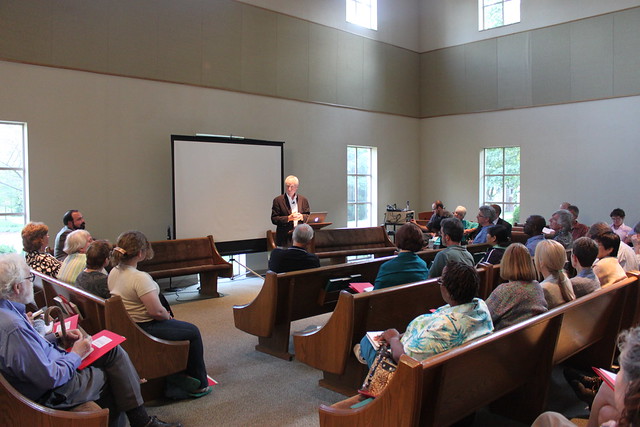
Joe Volk delivers his plenary address to attendees
I spent the past weekend with about sixty Friends who have an interest in leadership. Mine is a biased opinion, to be sure, but the collective buzz and the energy it generated were exhilarating. For the second consecutive year, ESR hosted a conference on leadership. It is one result of ESR’s decision to add a leadership emphasis within the M. Div. curriculum.
 
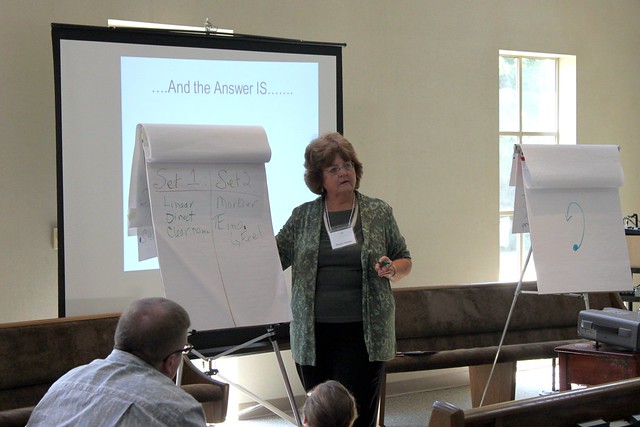
Attendees work in small groups during a workshop
This year’s theme, “Seeking the Core of Quaker Leadership”, captures the essence of the motivation for this new venture. The conference included presentations from: Joe Volk, who recently retired as executive secretary of FCNL; Bonalyn Mosteller, who works in the area of leadership development with Friends Services for the Aging; Alan Kolp and Peter Rea, who teach business persons about the integration of virtues and business; a panel presentation by businesspersons (Peter Laughter, Chiyo Moriuchi, Ray Ontko, and Lawrence Ross); plus some leadership with Earlham connections (Jennie Isbell, Paul Lacey, and myself). Friends, indeed all groups, benefit from good leadership. Where better to discover how such leadership can thrive than among Friends experienced with leading? 
 
Bonalyn Mosteller leads one of the workshops
This year’s event was rich and diverse in terms of experience. The attendance roster included leaders from the corporate and the non-profit world, religious and secular organizations, academics and practitioners alike. Attendees and presenters together contributed much weight to the learning experience. One exciting feature was the simple fact that about 2/3 of conference participants live outside of Richmond, Indiana. In fact, most of that 2/3 number live outside of Indiana! This indicates the topic has an appeal to a wide range of individuals, many of whom are willing to travel in order to participate. 


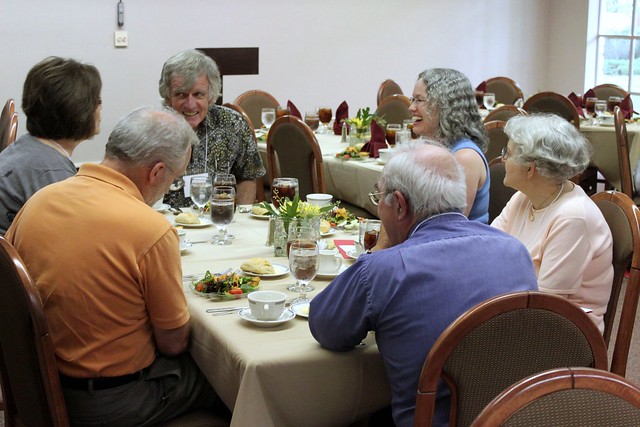
Attendees enjoy a meal and conversation
I made more new acquaintances at this event than any I can remember in the recent past, many of whom have skills and talents that I do not have but about which I would like to learn more. Even now, a breakfast conversation echoes in my mind. I was reflecting upon a new idea from the day before, and acknowledging that I did not know how to apply that to my work even though I could see its value. One person at the table said in response, “I can help you with that. That is what I do in my work.” Indeed, she has already sent a document describing how I might proceed and offering further assistance when I need it. 
 
Many of us have experienced the power and good results that emerge from the synergies of Friends who value implementation as highly as conversation. I hope that time will prove this to be one of those occasions.

Wednesday, April 6, 2011

Less-Anxious Leadership

By Jim Higginbotham

Being a less-anxious presence is a core concept of pastoral care. (The literature actually uses the term “non-anxious presence”; I think that's unrealistic.) Being anxious comes in many forms. For example, students in my classes are encouraged to recognize the ways they over-function in helping another person. Giving advice, asking too many probing questions, and doing things for someone who could do it for him/herself are some of the common ways that caring people try too hard to help. What students often discover is that the more they attempt to alter someone's behavior or feelings, even out of compassion, the less the other person changes. Ironically, doing less often has more power.  Under-functioning is another kind of anxious reaction, which is often related to a history of woundedness.

Systems theorists assert that managing anxiety is the key to effective leadership. The less anxiously a leader reacts to the dynamics of a group the more effectively s/he can guide them through even the most difficult situations. Less-anxious pastoral careUnfortunately, leaders, like everyone else in a group, have difficulty recognizing their own reactivity. Organizations of all sizes have particular, often unrecognized patterns to their interactions, which are most characteristically exhibited in difficult decision-making. Groups will repeat the same “mistakes” over and over, even when the leadership changes. In small groups, people take on roles as if in a play, and it is hard to escape these roles without leaving the group. This is most evident in families, of course. Even in large organizations, systemic dynamics encourage the leader to react in a certain manner: the leader rose to that position, in part, because his/her style fits the system.

Therefore, good leadership is often not about changing the group you lead, but changing how you react to the group. Less reactivity can affect group dynamics. Similar to pastoral caregiving, leaders need to recognize when they are trying to do too much or when they are helping the group continue to spin in a direction that hasn't worked. In the latter situation, pushing the group to change directions probably won't be effective. However, if a leader stops enabling the current patterns and reacts with less anxiety when the group “rebels” against this new style, the group might slowly begin to function in a new manner. Organizations will also react strongly when one stops over-functioning. For many of us, it is hard not to rescue a group when it seems like it will fail without our doing what we have always done. However, good leadership has to allow the members to do what they can do for themselves, even if it means they have to learn the “hard way.”

So, what do you think about this idea of becoming a less-anxious presence as the heart of good leadership?

Jim HigginbothamJim Higginbotham is Assistant Professor of Pastoral Care at Earlham School of Religion. He live in Indianapolis.

Monday, March 7, 2011

Leadership Formation at ESR

By Jim Higginbotham

I believe that a good leader attempts to respond in a relatively less-anxious manner to the powerful dynamics of an organization's system. When a group begins running around like they're rearranging chairs on the deck of what seems like a sinking ship, instead of trying to direct people over the howling winds (as the group expects), a leader might simply sit down on one of the chairs in the middle of the deck. Even if we can't calm the winds like Jesus did when his followers were panicked in the storm, we can exhibit peacefulness when others are overwhelmed.

As the above image implies, I believe that becoming a good leader is a product of spiritual formation. Only when we are well-connected to theCarving Pumpkins at ESR depth of who we are created to be can we live less reactively (among other important qualities of a good leader). Jesus' ability to inspire and empower his followers was directly connected to his depth of spirituality. He constantly went away to pray before important events in his life. Similarly, we need strength from a Source that will help us to face challenges less afraid and not anxiously respond to the pressures that a group places upon us. In other words, we can not act peacefully if we do not possess peace.

This spiritual formation requires self-awareness and a willingness to open ourselves up to a transforming Spirit. Although the Gospels seem to portray that Jesus developed his own spirituality, if this picture is completely accurate, it was only due to his unique relationship with God. We need others to help us understand our strengths and growing edges as well as to connect to the power of the Spirit. That is one of the primary reasons that Earlham School of Religion focuses our program on spiritual formation; it is a corporate activity that can't be done only in isolation. We need to worship and pray together to find our spiritual center. When we are vulnerable with spiritual friends and others whom we can trust, they Jodi and Shelley - Friends at ESRcan help us to recognize our gifts and the areas in us that need to be transformed. Usually, hidden parts of our soul are the source of our anxious reactions to others.

For example, a goodhearted person might sometimes rescue others when they don't need so much help because s/he is uncomfortable with seeing people struggle. A hidden part that this person might need to discover is that s/he feels responsible for others' pain even if s/he hasn't contributed to it. This person takes responsibility for the struggles and thus robs others of the chance to grow from facing their own challenges. Such over-responsibility is not just a personal foible, but it is also a spiritual issue. This hypothetical person needs to learn to turn their concern over to a Comforter that can empower others in their struggles. If we believe that there is a power greater than ourselves, we must learn to trust this Spirit. It can be difficult when we feel uncomfortable, but having faith that God will be present frees us to do what we do best and allow others to use their strengths and gifts as well.

Obviously, leadership requires knowledge and many kinds of skills which seminary helps to develop. ESR's program is based in spiritual formation, because the world needs leaders formed in faith.

Jim HigginbothamJim Higginbotham is Assistant Professor of Pastoral Care at Earlham School of Religion. He live in Indianapolis.

Monday, February 28, 2011

Want Leadership? Develop Followership.

By Lonnie Valentine

I do not see the problem of leadership as one of finding people willing and able to lead.

I see the problem as one of "followership." Those who see themselves or are seen as followers are thought of as less worthy than leaders. So, everyone wants to be a leader and no one wants to follow. If so, thenBrent Bill leading a presentation any talk of leadership needs to talk about followership. How do we be good followers?

Of course, this is not a new problem. Paul talks about these issues, and it is clear he and the congregations he started struggled with this question of who is to lead and who is to follow. However, I did find some of what Paul says to be worth thinking about now:

"There are varieties of gifts, but the same Spirit; and there are varieties of services, but the same Lord; and there are varieties of activities, but it is the same God who activates all of them in everyone. To each is given the manifestation of the Spirit for the common good...For just as the body is one and has many members, and all the members of the body, though many, are one body, so it is with Christ." (1 Corinthians 12: 4-7, 12)

Playing off of Paul's image, I would think that, first, anyone who leads ought not think of themselves as inherently superior to those whoSinging at ESR worship follow, and those who follow ought not think of themselves as inferior in their following. Second, a leader in some situations had better be able to show they can follow in other situations. A leader needs to model following at times. As Paul notes, not all have the same gifts, and so the gifts of others need to be recognized and brought into the lead at certain times. Third, I think there is need for some person or few persons that have a responsibility for paying attention to how the whole body of the group is functioning.

This form of leadership, usually thought of in relation to the role of administrators, is most critical in helping all the other sub-groups and persons of the organization to see what the overall mission and health of the body is. This does not mean they seek to be "the decider" and make all decisions or have all power, but rather they have a gift for holding the various roles and ideas of all those who are members of the body so as to communicate to all what is going on in the body, and seeking toLonnie Valentine delivering a message at ESR worship promote the mission or heal the hurts of the entire group by seeing and calling forth the talents of those in the body.

One final word. Last Spring, John Dominic Crossan lectured at ESR on the vision of the Kingdom of God held by Jesus and Paul. He argued that their vision of such a Kingdom was a direct challenge to the Kingdom of Caesar. Caesar's kingdom was top down, with Caesar as the divine Son of God who ruled as a dictator, using coercion and violence to maintain control. Unfortunately, such a model has many attractions, during the time of Jesus and Paul and in our own time, including within the Church. Such a quest for power led to Empire making which destroyed others and finally was self-destructive.

As Crossan puts it, ancient Greece learned it could have participatory democracy or Empire, but not both; Rome learned is could have a republic or Empire, but not both. Insofar as any body, whether it be Church or State--or educational institution, sees itself as building an Empire, then the health of the body is endangered. The Church or any organization is to be of service to others, not to accrue power and privilege for itself or for some of its "leaders."

Valentine, Lonnie.JPGLonnie Valentine has served as professor of Peace and Justice Studies at Earlham School of Religion since 1989. Originally from California, he lives in Richmond, Indiana.

Monday, February 14, 2011

What does leadership mean to you?

“Leadership” is a concept heavy-laden with experiences of mentors, meetings, pastors, employers, and others who have gone awry. In the Religious Society of Friends, with its theology of egalitarian relations, “leadership” is a concept that is often downplayed and reduced to its least intrusive, least offensive manifestations. To me, leadership is a calling in and of itself; a field of study, requiring a hard look at oneself and a penchant for discerning how groups of people and organizations function together. It is a life-long process of paying attention to not only where the Spirit is leading this group or the other, but also paying attention to the direction the Spirit is not leading.

Many times, I have encountered comments and opinions in experiences of group cohesion and group conflict that reduces the groups’ behavior to simplistic psychological explanations for this phenomenon or that. Examples of this include: ¨S/he is just speaking out of fear¨and ¨That is just an angry person with issues¨. Groups, in and of themselves possess their own sense of personality, mission and calling that goes beyond simply that of the individuals of which the group is comprised.

Leadership involves the inclination, proclivity and desire to see beyond the bounds of what the group is discerning in efforts to guide the group beyond its current limitations. It entails the ability to see the group´s personality and tenor as more that the emotions or thoughts of any one individual. This involves being willing to stick one’s neck out, state the obvious, push and pull, gauge what impetus would Students at Common Mealwork and which would not, fall, and yes, be pushed down. It involves surrounding oneself with mentors and friends that can brush one off and help one to stand again.

Much has been written about the integrity and consistency necessary to leadership, but I see these attributes as being necessary of any one involved in the work of God, and as Friends, each of us is about the work of God. Being a leader involves being trustworthy enough for those who feel vulnerable to follow one out onto thin ice anyway. Think about the leaders that surround you in your life. Who would you follow? Who knows the group well and pays attention to the group as a whole and not just smaller constituencies or individuals? Who would stay to pick you up if the plan is a bust and not flee, refusing to leave you behind, refusing to blame you for the bust? Who would celebrate with you or grieve with you? And then who would ask you to do it all over again? And to whom would you say, “Yes, I’ll give it a try again”? Those are the leaders.

vanloapApril Vanlonden is a recorded minister in Western Yearly Meeting, and has served as a pastor in Indiana Yearly Meeting. With over twenty-five years of experience serving in the non-profit sector in a variety of leadership positions, she presently serves as Director of Academic Services at Earlham School of Religion and Bethany Theological Seminary.

Wednesday, February 2, 2011

What does "leadership" mean to you?

I sometimes joke that God called me to be a pastor to a group that can’t make its peace with pastoral ministry, to be an Old Testament scholarJay in conversation among a people that is ambivalent about the Bible, and to be a leader within a group that really doesn’t want to be led. One has to be willing to “swim upstream” to find joy in those types of calling. Still, I’ve gladly said “yes” to each of these opportunities and relish the challenges they bring.
The latter call, that of leadership, is very much on my mind these days. From personal, institutional, and communal perspectives, it begs for attention. While it is true that leadership can be a troubling concept for Friends, I have come to believe that we should move beyond our old hesitations. We would benefit from fussing less about the things that can go wrong, instead investing time reflecting upon the topic and developing an understanding of leadership that can function well in our context.
At its most basic level, I have come to hold that leadership is stepping forward in answer to the leading of the Spirit, offering the gifts and skillsESR student speaking at Common Meal with which one has been equipped.  For that to be a legitimate understanding of leadership, it must grow out of one’s ongoing dialogue with God. This means leadership is very much integrated with one’s spirituality, even though most theories of leadership leave no room for spirituality. It also means many of us, perhaps all of us, have moments of moving into and out of leadership roles when, for some duration of time, we have the right offerings to meet the needs of the moment.  From this perspective, leading is a form of faithfulness shared by virtually everyone.
Having said this, I would distance myself from the position of “everyone is a leader” which at some point devolves to mean, “no one is a leader.” I am willing to say that while all people have opportunities to lead, and all leadership is valuable, not all leadership is equal and some is more permanent than others. That statement may not gain wide acceptance among Friends. However, I believe that spiritual equality before God does not translate into positional equality within an organization or topical equality on every subject to be discussed or decided. There are topics I know little or nothing about, and even if a Quaker context means I can contribute to the discussion, and even though it is possible God may speak through me, I do not enter some discussions expecting to carry any weight.
Leadership as a response to call differs from leadership as raw talent in at least two crucial ways: first, its authority is rooted in God’s calling andESR student speaking at Common Meal equipping, not in charisma or skill; and second, it asks early and often, “for what purpose am I leading?” This question helps the leader to remember that the purpose for leading has God’s call and the community’s well being in mind. It is less about imposing one’s own vision on the group or satisfying ego, and more a matter of helping the group discern and respond to its own call as defined by its mission. With that said, leadership is offered in the hope that it contributes to God’s work, as well as to the life and health of the group receiving the leadership.
Leadership almost always presents an opportunity to influence the group that receives it. I could have easily said “an opportunity to serve the group.” There is a service capacity to good leadership, but I am careful about the use of “servant” with regard to leadership among Friends. Friends employ the term often, usually without having ever read Greenleaf’s work on servant leadership. I believe Friends in general have not yet matured enough in our thinking about leadership to use the term “servant” without qualification.
I am aware that the idea of one person influencing another makes some Friends uneasy, but the idea that all influence is bad or that we can live aCarrie Newcomer at ESR life not influenced by others is indefensible. At the core are worries about power and authority that seem to be embedded in Quaker DNA. If Friends are to make progress thinking about how leadership can flourish among us, we are going to have to speak the truth to ourselves about terms like those. It is not that Friends do not have authorities and powers among us. Rather, our tendency is to camouflage them, or perhaps simply fail to recognize them because they we are so immersed in our own assumptions.
I know that I am going to be influenced by others, and many times will even be unaware of those influences. Given that, I’d prefer to be influenced by those who lead with clear objectives and right motives.
6Jay Marshall is Dean of Earlham School of Religion and a native of North Carolina. Before beginning his service at ESR, he was a pastor in Western Yearly Meeting.