By Steve Angell
Heredios Santos, long-time pastor in Cuba Yearly Meeting, first mentioned the possibility of my going to Cuba in 2001. In 2008, there was an important informal meeting of Friends interested in Cuba at the  meeting of the Section of the Americas of FWCC in Jackson County, Indiana. I was among those present. Maria Yi Reyna, pastor of the church in Holguin, Cuba, mentioned that the great need of the Cuba Yearly Meeting from Friends in the Americas was for resources to bolster their Quaker identity. A number of us sitting around the table were excited by this. Led by Kristen Richardson, the American Friends Service Committee sent a “Traveling Seminary” to Cuba Yearly Meeting in February of this year, with their Brazil rep, Jorge Lafitte, offering valuable workshops to Cuban Friends on non-violent conflict resolution and social change theory.
Meanwhile, Jay Marshall was in contact with the Clerk of Cuba Yearly Meeting, Ramon Gonzalez Longoria Escalona, and arranged a visit to the Yearly Meeting for me this February and March. I was invited to give a series of lectures at the Yearly Meeting sessions themselves, and afterwards a lecture at the Young Adult Friends Retreat and three workshops at the newer monthly meetings in Cuba.
A few observations about the background of Friends’ ministry in Cuba
I arrived in Holguin, Cuba, one of the larger cities in Cuba, at the eastern end of the island, on February 21. The following day, along with three representatives of New England Yearly Meeting, Benigno Sanchez- Eppler, Victoria Rhoden, and Noah Baker-Merrill, I traveled the thirteen kilometers to Gibara, where the yearly meeting was to be held. Gibara is a small town of about 30,000 people on the coast. Hurricane Ike caused major damage in 2008, destroying much of the seawall. There has not been any money to repair the damage to the seawall. Friends in Gibara sheltered dozens of people in their church during the hurricane. Fortunately, there was very little damage to the church itself. They lost only a small portion of their roof. Also fortunately, Cubans were well prepared for the hurricane, and on the whole island, only two people lost their lives.
In the day before the Yearly Meeting sessions started, Benigno, a native of Cuba who emigrated to the United States at age 13, tried to orient us to the realities we would see around us. He emphasized that the 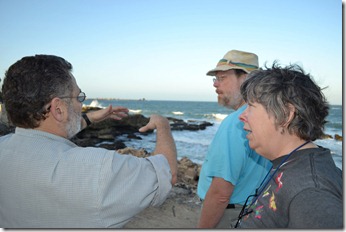 orientation was coming through a particular lens – that is, his. The Cuban Revolution has emphasized human equality, but unfortunately, it has ended up with a process of equal immiseration, that is, everyone becoming equally poor. The Cuban government is the single employer. All property, including church property, belongs to the Cuban government – the Cuban government allows churches to use certain property, families to live in certain houses, and so forth, but all land belongs to the government. Industry and wages are at a very low level. Monthly wages of $15 to $25 are fairly usual for Cubans. It is not a living wage.
The Cuban revolution, Benigno said, was built on five pillars: Schools; Medical Centers; the Military; Prisons; and Emigration. So Cuba has a relatively high degree of educational attainment. It has an extraordinary high degree of doctors per capita. However, there are few jobs for those who finish schools. Doctors are paid very low salaries. Medical  consultations are free, but medicines are very difficult, if not impossible, to obtain, even over-the-counter medicines such as pain relievers. In the stores, there is virtually nothing for sale. There are, for example, no cars for sale; the few cars that one sees on the roads are 1950s American vehicles, often lovingly and painstakingly maintained, or later era Soviet cars, but none of recent vintage. The Cuban monetary system is very difficult to figure out; the Yearly Meeting treasurers keeps accounts in three currencies, the regular Cuban peso, the convertible Cuban peso, and United States dollars. An international like myself can carry the convertible peso, but is not allowed to carry regular pesos. (The informal exchange rates for those two currencies are remarkably different.)
With the military and prisons, there is a high degree of state control. There is virtually no place for open expression of political dissent. One of  the complicating factors for gathering people for the Yearly Meeting sessions was that in one of the cities where there is a Friends Church, Banes, Mothers in White, a group of Mothers for political prisoners, was gathering for a protest. So the Yearly Meeting bus (the Wawa) would have to penetrate intense presence of security forces in order to bring Friends from Banes to the Yearly Meeting sessions.
It is hard to walk very far on the streets of Gibara (something that I did every day) without having someone approach you to ask for money (often quite desperately). During the time that I was there, I talked with two men, one younger and one older, who had received permission to  emigrate to the United States. If a resident of Gibara receives remittances from someone working in the United States, they will be much better off than the ordinary Gibaran. One day, the three New England Friends, a Cuban Friend, and myself were walking through the streets of Gibara. The Cuban Friend explained how every house we saw with a fresh coat of paint was someone who had a spouse living abroad who sent remittances. Remittances are the second most important source of income for the island of Cuba (the most important source is tourism, all those happy Canadians that I flew down to Cuba with, and also back to Canada with.)
Getting news in Cuba is a challenge. There is no internet, and only very limited television and newspaper news coverage. Ramon, in Gibara, had to work hard to have a periodical delivered to him, and finally settled on a weekly (the Juventud). The big city Friends’ Church (Holguin) was able to have a daily delivered, the Granma. Unlike Iran, there is no English language news service – it is also in Spanish.
Yearly Meeting Sessions
It was a wonderful group of Cubans who gathered for Yearly Meeting. My lectures covered different areas of Quaker doctrine: the true nature of Quaker Community; Quakers and holiness; The Holy Spirit and Revelation; the Light of Christ; and Quakers and the testimonies. For the first two lectures, I read  them from manuscript; the last three were spoken from the silence. I spoke in English, and Benigno translated for me.
The Yearly Meeting sessions were very lively. They completed an extraordinary amount of business. The list of the Action Minutes from the Yearly Meeting comes to 57 Minutes, and when printed out, they cover four pages, single spaced. The clerk does a lot of talking there, but Yearly Meeting members are not shy to express themselves when the Spirit leads. The items that led to the most extensive discussion were the Nominating Committee Report and the proposal to build a meeting house for the Programmed Meeting in Havana. In Havana, the programmed Friends meet in a space they rent from the Episcopal Church, and the latter has not always been hospitable. The Havana Friends proposed to throw a slab on top of the house of an existing member, but there were various problems with that, most notably, that Cuban law would not allow any deeding of the 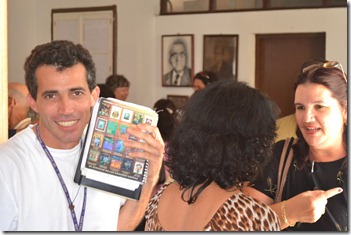 nascent meeting house to Friends until the slab is actually completed, at the cost of $10,000. After considerable discussion, the Yearly Meeting approved a very diplomatically worded minute postponing any further consideration of the Havana Friends proposal, until after the change of the property laws expected from the Government in April. The Clerk, Ramon, tells me that he thinks the problem with the Episcopal Church is mostly at the local level, and that involving the Episcopal Bishop for Cuba may be able to resolve the problems between Havana Friends and the local Episcopal Church.
Another issue was starting up a Center for Quaker and Peace Studies, to supplement what theological education is available elsewhere in Cuba. More on that later.
The Friends’ Church in Puerto Padre desperately needs repair work. The school was confiscated at the time of the Cuban Revolution and is now in great disrepair, missing some (or most?) of its roof. Cuban Friends are trying to reclaim the school, and also need to find their title (or claim of title: legalities in respect to property questions are very complex) to the Church property in order for repair work proceeds.
My first three lectures went well, but when my fourth lecture was scheduled, for Saturday night, I was suffering from severe intestinal distress. I felt that I could attend and also that I could say something,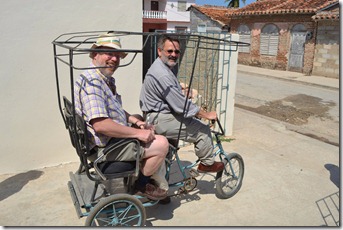 but I did not feel up to speaking for the entire hour. I did speak for five minutes at the beginning out of the silence, but then I sat down and ceded the floor. The Holy Spirit was in charge, and it worked out well; several Friends, Cuban and North American, spoke out of the silence. Noah Baker-Merrill, a gifted minister from Vermont, spoke movingly about his experience with the Light. By the time of my concluding lecture on the Testimonies the next day, I had recovered and that also went well. That afternoon, busload after busload of Friends left the Yearly Meeting compound in Gibara. New England Friend Victoria Rhoden commented that, “four days ago, I did not even know these dear Friends, but now I find myself crying as they are leaving.” It was indeed a very poignant moment.
Workshops that I offered after Yearly Meeting Sessions
The next day, Monday, Feb. 28, was the occasion for an outing on the beach, with the clerk of the yearly meeting and his family, and all four of us from the United States. The following day, I bid adieu to the New England Friends. My first workshop was in a smaller church in Holguin, by the name of Vista Alegre. I presented a session on the Testimony of Simplicity, and then my full presentation on the Light of Christ, contrasting the views of George Fox, J. J. Gurney, and Rufus Jones.
Then it was back to Gibara. That weekend the Young Adult Friends were gathering for a retreat. In many ways the Young Adult Friends are the  backbone of the Yearly Meeting. There are nine monthly meetings in Cuba. The Clerk (Presidente) of Cuba Yearly Meeting, Ramon Longoria, is the pastor of the monthly meeting in Gibara. Most of the other monthly meetings are pastored either by a Young Adult Friend, or by someone who is only a few years removed from Young Adult Friends status (the upper age limit, there as here, is 35 years old). So, when I talked to the Young Adult Friends at their first session on Friday night, Mar. 4, I soon realized that I was talking to the emerging leadership of the Yearly Meeting. One thing that Cuba Yearly Meeting is asking for when they say they need help with issues of Quaker identity, is help with the spiritual formation of these Young Adult Friends who have stepped up into greatly needed positions of leadership in the Monthly Meetings.
I had been told that Young Adult Friends were very much concerned about issues of the Second Coming, so my talk on “the essentials of Quakerism” focused somewhat on the realized eschatology of early Quakerism, and how that connected to issues like early Quakers’ views of the sacraments. The next day had four sessions. One was a panel with three speakers addressing the three controversial issues among Young Adult Friends: what do Quakers think about the second coming; what do Quakers think about Satan; and should Quakers adopt a position of more latitude in terms of what church music are allowed into Friends’ churches.
This all plays into the Quaker identity issue in one way or another. Take church music: Quakers in Cuba are clear that they are not Pentecostal. They are concerned about the waves of Pentecostalism in Cuban culture that threaten to overtake various forms of Cuban Christianity. One evening, while I was riding on the microbus, we passed a Pentecostal church service that was just ending. There were hundreds of people walking away from the church service. It was clearly very popular. Cuban Quakers like individual Cuban Pentecostals, (some work for Quakers in positions such as garderner) and even invite Cuban Pentecostal groups to rent their church complex: the “Orthodox” who rented the Gibara complex while I was there were Pentecostals, I was told. But Cuban Quakers are not about to adopt a premillennialist position on Second Coming for example.
One of the further workshops was offered by Lazaro, pastor of the Friends’ Church at Velasco, on the topic of “evangelization.” He asked me briefly to speak about evangelization in the United States, and I mentioned that evangelization by way of crusade seems on the decline here, but that the internet (both websites and blogs) were becoming more important in the US. I have a sense that evangelization in Cuba is quite different, especially since they have no internet.
The last week that I was in Cuba, I presented two more workshops. I visited the eastern end of the Yearly Meeting, in the neighborhood of Banes, the headquarters for  the United Fruit Company prior to the Cuban revolution. The Banes church is beautiful, with three F.U.M. work teams having done great work in restoring it. There is a beautiful garden in the Banes complex. Hurricane Ike occasioned great damage. Cuban Friends spent fifteen full days just getting the fallen trees and debris out of the Banes church grounds after the hurricane. But the garden has made a great recovery, albeit with many fewer trees.
This workshop was held in El Retrete, a church mission that was just given monthly meeting status. I was privileged to see the ceremony at which El Retrete received Monthly Meeting status. Within the space of a couple of hours, a Nominating Committee was 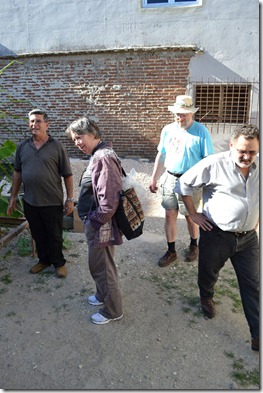 appointed, met, made its report, and the new Monthly Meeting, with help from many wise elders throughout the yearly meeting, composed its first minute. I then conducted a workshop, which included my Light of Christ talk, and a session on Quaker Spirituality focusing on John Woolman. My last workshop, at Bocas meeting, incorporated just the Light of Christ talk.
Cuba Yearly Meeting is a wonderful place that has accomplished much in two short decades under daunting odds. When the most severe repression ceased in Cuba, Cuban Quakers had less than 100 members. Anyone can tell you who were the faithful ones, the handful in each meeting, who kept the Cuban Quakers going in the years when the Cuban Communists were officially atheist and trying to put religion out of business. They are now up to about 500 members. Will they be able to keep their church growing?
 Steve Angell is the Geraldine Leatherock Professor of Quaker Studies at Earlham School of Religion.


%5B3%5D.jpg "Carole and David Woods (guide)")


