Time and again during our eight
days in Cuba, we saw hope. There was never not hope there. I do not know why it
was so surprising to me. Hope is a core belief of who I am, yet I could not
stop myself from loving the shock and aww I felt over and over as each day we
met a new person with endless amounts of hope for Cuba. I grew up thinking the
worst about Cuba. I was taught it was led by an evil man with evil plans and
filled with evil people because they would choose to stay there. The only
people there we ever felt compassion for (at least in my childlike
understanding of the Cuban existence) was the ones we heard about trying to
escape such as the family of Elian Gonzalez in 2000. I can now say that I have
spent time on the other side of this conversation, and in the words of my
beloved Professor at ESR (Rev. Dr. Nancy Bowen), “it is complicated.” Indeed,
it is complicated. On our American side, we have been given only our side of
the story, and in Cuba they have been given theirs. My mother always taught me
there are three sides to a story: yours, mine, and the truth. Somewhere in the
middle of both our sides of propaganda and experience, there is truth; there is
hope.
Monday, June 18, 2018
Samantha Hasty: Seeing Hope in the Hopeless
ESR MDiv graduate Samantha Hasty offers the following reflection on her recent travel as part of ESR's Contextual Theology Intensive to Cuba May 20th-28th, 2018:
Monday, June 11, 2018
Keelin Anderson: Highlights from the 2018 ESR Contextual Theology Intensive to Cuba
ESR MDiv student Keelin Anderson offers the following on her recent travel as part of ESR's Contextual Theology Intensive to Cuba May 20th-28th, 2018:
Living in Cuba
My dorm room in the Centro Martin Luther King (CMLK) in Marianao,
Havana, was surprisingly comfortable, with AC and a bathroom with shower. Things
do not work the same in Havana as in Portland, OR, where I live. Due to the US
Blockade of trade with Cuba, Cubans have limited access to many basic aspects
of life that I take for granted. Most of the toilets we found did not have
seats, presumably because they wore out 20 years ago and could not be replaced.
At times we had to go without napkins and toilet paper. The water is not as
clean as in the US. We were told to avoid consuming the water (including ice in
beverages, teeth brushing, and fresh veggies or fruit). This was not only
impossible to do, but confusing as we were told everywhere we went that the
water and food was safe. I think most of us got sick at some point during the
week, a few severely.
Wednesday, April 25, 2018
New Student Introduction: Brown Mujete
We are excited to begin introducing to you some of our incoming students for the fall 2018-19 entering class. Our first introduction is from Brown Mujete, who joins us as an MA International Cooper Scholar from Kenya. He shares some thoughts on coming to ESR below:
I was born and bred in the western province of Kenya to
Christian parents and pastors in the Friends Church Quakers. I’m the third born
in a family of four; a brother and two sisters. I schooled in northern Kenya (Turkana
County) for both my primary and secondary education where I met and accepted
Christ as my Lord and Savior.
After
high school, I joined Friends Theological College – Kaimosi in 2006 to pursue a
Diploma in Theology which is my passion. While in Kaimosi, I served as a
chaplain and a pastor to various schools and churches. In 2009 I moved to
Lodwar where I served under Pastor John Moru as the youth pastor in Lodwar
Monthly Meeting Turkana County.
I
later joined St. Paul’s University – Limuru – Kenya for a bachelor of divinity
program and graduated in 2012. My ministerial passion is teaching and preaching
the gospel, serving with the elderly people, mentally challenged and people
with various disabilities. I like listening to people with various challenges,
praying with them and offering myself to help where possible.
In
December 2015 I got married to Petra at a colorful church wedding at Eldoret
Town Village Meeting. We are foster parents to baby Alexis Judy (18 Months old)
whom we took in when she was 2 months old after her mother requested us to do
it since she was a student and unable to fend for her. On 23rd March
2018 God blessed us with a baby Boy Drake Jeremy.
Petra
is pursuing a diploma in finance and accounting at the moment graduating in
November 2018. Our dream is to develop a home for the elderly and people with
psychological disorders in western Kenya.
We
looking forward to joining ESR to learn and gain new experience from friends
for the betterment of the ministry we have been called to.
Monday, March 26, 2018
God in the Checkout Line
ESR MDiv student Keelin Anderson prepared the following essay for the Pacific Northwest Quaker Women's Theology Conference coming up June 6-10, 2018, in Canby Grove, Oregon:
I am currently
staying for a few months in a small town called Richmond in rural Indiana.
Unlike my neighborhood in Portland, OR, there is no Whole Foods here, no
organic kale, no unbleached toilet paper, no vegan deli, and few who could
afford these things if they were available. The local grocery store does a find
job, but they do not have the staff to rush to open a new cash register when
the line gets longer than two customers.
Friday, March 23, 2018
Practicing Mysticism in the World
ESR Board of Advisors Clerk Dwight L. Wilson delivered the following message during ESR worship on Thursday, March 22, 2018:
![]() |
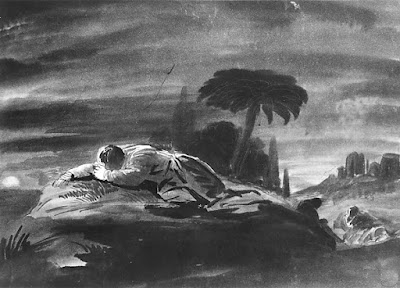
| Christ in the Garden of Gethsemane, Robert Walter Weir |
Jesus was my first hero. I expect him to also be my last. One of my favorite stories is of him in the Garden of Gethsemane praying, "If it's possible, remove this cup." We don't read the answer; it is implied. This is almost universally true in the Gospels. Jesus prays. By his actions we learn the answer.
I write modern psalms directed to the Holy One. I am a mystic who, like Jesus, receives my answers in organic surround sound. From the Spiritual Source I act out my response. This has been true since in nearby Middletown, Ohio I became both the first conscientious objector I had ever met and the first black protester I knew to take complaining to the streets. From the activation of spirituality I am happy to say I have photos of my three young grandchildren demonstrating separately at multiple sights in California and Kansas. One person is an aberration. A second generation is a trend. A third generation is a family tradition. As Jesus' brother said, "Faith without works is dead."
Monday, March 5, 2018
When God is calling
ESR MDiv student Keelin Anderson delivered the following message during ESR worship on Friday, March 2, 2018:
Luke 9: 1-6 NRSV
Then Jesus called the twelve together and gave them power and authority over all demons and to cure diseases, and he sent them out to proclaim the kingdom of God and to heal. He said to them, “Take nothing for your journey, no staff, nor bag, nor bread, nor money—not even an extra tunic. Whatever house you enter, stay there, and leave from there. Wherever they do not welcome you, as you are leaving that town shake the dust off your feet as a testimony against them.” They departed and went through the villages, bringing the good news and curing diseases everywhere.
Luke 9: 57-62 NRSVAs they were going along the road, someone said to him, “I will follow you wherever you go.” And Jesus said to him, “Foxes have holes, and birds of the air have nests; but the Son of Man has nowhere to lay his head.” To another he said, “Follow me.” But he said, “Lord, first let me go and bury my father.” But Jesus said to him, “Let the dead bury their own dead; but as for you, go and proclaim the kingdom of God.” Another said, “I will follow you, Lord; but let me first say farewell to those at my home.” Jesus said to him, “No one who puts a hand to the plow and looks back is fit for the kingdom of God.”
I joke here, but Jesus is saying his call is not an easy one. There will be people in your life who will not understand. There will be habits and assumptions of your own you will have to leave behind. God is calling for an ongoing radical transformation in your way of being in the world. Not everything and everyone in your life is going to come along with you.
Three years ago I was minding my own business, walking home from a yoga class in my neighborhood in Portland, OR, when an idea popped into my head. “Go find out what it takes to become a hospital chaplain,” it said. I had been a nurse and a massage therapist, so in a way this made sense, but I had never had a religion. I was raised by divorced parents, my mother a scientist and atheist, my father, a psychiatrist who during my teen years, lived in a cult that followed the Bhagwan Shree Rajneesh. Religion at the least was suspect, at the most, dangerous.
I had come to my own sense of God in my late twenties through meditation, a practice I mostly did by myself. It had never occurred to me to do religion with other people. My sense of religious people came from American media. Throughout the world people were fighting wars in religion’s name. At home, “Christian family values” meant homophobia and misogyny. As far as I could see, religious people wanted either to control me or kill me. Now God wanted me to get an MDiv?
And here I am three years later giving a sermon! I have not made a dime since I began school. I have abandoned my husband and two cats alone at home in Portland for this Spring Term. I have discovered I am a Quaker. I am learning to appreciate that there is something to this “gathering together in Jesus’s name.” I feel more able than ever to express my true self and allow God to move through me, and, I have to work constantly on my faith and courage.
Thursday, October 26, 2017
Jephthah’s daughter then and now
The other day, after grading a set of Intro to Old Testament Studies papers, I posted on Facebook, “It’s a good day when you learn new things about how to read well known texts from your students.” This post by ESR M.Div. Access student Nikki Holland is one of the papers I learned from. The assignment was to write about what you would say about one of the women from Joshua and Judges for an adult Bible Study group. Nikki chose to write on Jephthah’s daughter (Judges 11:29-40). I invite you to read what Nikki’s response. I hope you find it as illuminating as I did.
From the surface, the story in Judges 11:29-40 seems foreign and weird to us. A man makes a foolish vow and keeps it, though it results in the death of his daughter; and what is maybe more astonishing, she participates. But with a close examination of this story, we can see several themes that echo through our lives today.
- Nancy R. Bowen (Professor of Old Testament)
From the surface, the story in Judges 11:29-40 seems foreign and weird to us. A man makes a foolish vow and keeps it, though it results in the death of his daughter; and what is maybe more astonishing, she participates. But with a close examination of this story, we can see several themes that echo through our lives today.
1) Victim blaming
Upon realizing that he has vowed to
sacrifice his own daughter (hereafter called “Daughter”), Jephthah lays the
blame immediately on her head. “You have brought me very low,” he says. “You
have become the cause of great trouble to me” (Judges 11:35). He explains that
he has made a vow, but the emphasis is on her culpability. Never mind that he
made a foolish vow and she was simply fulfilling her role as a faithful
daughter in celebrating his victory.[1] Jephthah
deflects blame from himself onto Daughter. I hear echoes of his words in my own
generation, “Look what you made me do…” and “Well, you shouldn’t have been in
that place anyways."
Thursday, July 20, 2017
Preparing for war: Are we ready?
ESR Professor of Peace and Justice Studies Lonnie Valentine shares a reflection on the importance - and timeliness - of conscientious objection to war:
With the love of war growing strong, what will follow after
the attack on Syria, the “Mother of All Bombs” dropped on Afghanistan, and now
the threats directed at North Korea? As
with all previous war-making, this US administration sees how the people praise
war. Presidents going to war show
strength. Is it so that every US President must have his own war? Is our government now preparing to do what
Mark Anthony exclaims in Shakespeare's play Julius Caesar: “Cry
‘Havoc’ and let slip the dogs of war” (Act 3, Scene 1)? Unlike us, Mark Anthony was regretting that
this would be the cry heard as the Roman Empire descended into civil war. He says:
“Blood and destruction shall be so in use
And dreadful objects so familiar
That mothers shall but smile when they behold
Their infants quarter'd (i.e. cut to pieces) with the hands of war.”
And dreadful objects so familiar
That mothers shall but smile when they behold
Their infants quarter'd (i.e. cut to pieces) with the hands of war.”
![]() |
| Richard Burton and Elizabeth Taylor in Cleopatra |
And so it came to pass that Mark Anthony entered the Roman civil
war. However, he faced the one who would become Caesar Augustus. Anthony lost
the war and fled to Egypt with his queen, Cleopatra. Reaching the shore, they
committed suicide together.
![]() |
| Real child soldier, US Civil War |
And so what of those of us who seek a
better way? Many young people have been
drenched in war propaganda and think it could be grand. My spouse, Genevieve, is the piano
accompanist to a middle school choir. One girl was wearing a sash and Genevieve
asked what it meant. The girl replied,
“I am a diplomat. I and the other diplomats will gather to make war.” With
Genevieve's horror discussion ensued, but the young ones replied: “Peace is
boring; war is fun.”
Of the many things that we can do to prepare for war, here is one option for consideration: Quakers and others seeking peace and pursing it need to teach
our own young people about the option of conscientious objection to war.
Monday, June 19, 2017
New student introduction: Mebin Mathew
We are excited to begin introducing to you some of our incoming students for the fall 2017-18 entering class. Our first introduction is from Mebin Mathew, who joins us as an MDiv Cooper Scholar from Bangalore, India. She shares some thoughts on coming to ESR below:
My full name is Mebin K. Mathew. I am basically from South India. Kerala is my home state but I was raised in Bangalore, India which is also called the Garden city of India. I speak four languages including my mother tongue. During my childhood days, I have also been in many North Indian States like Punjab, Bhutan, Delhi because my dad was working with the Indian Army. My mom was working as a nurse in military hospital. They both took voluntary retirement from their jobs and dedicated their lives for serving the Lord. My dad is a pastor and my dad and mom are working among the Indian unreached people group.
I did my basic schooling in one of the English medium schools in Bangalore and finished my Bachelor of Arts (B.A) specializing in Journalism, Psychology and English Literature. I got married to Binu B Peniel. My husband Binu just finished his Doctorate from United Theological Seminary specializing in Pastoral Care and Counselling and his research was in Human Trafficking.
We are blessed with a daughter (Keren) who is 7 years old now. She brings so much of joy to our lives. Especially I just want to thank God for bringing us here in this wonderful country and to this great school. We truly believe Earlham School of Religion is a great opened door for us. I am so grateful to God for giving me this opportunity to study here and to answer God’s call upon my life.
I am looking forward to get to know each and everyone one of you in person. Really excited about it.
Thank you.
Blessings,
Mebin Mathew
Thursday, May 11, 2017
Reflections on a Sojourn in Switzerland: Time, Friendship, and Faith
In this reflection ESR MDiv student Anne M. Hutchinson shares about her recent visit to Switzerland:
It’s
hard to conceive of Switzerland without thinking of chalets, cheese, chocolate,
cleanliness, and clocks. There are indeed chalets with their wide roofs and
elaborate exterior wood carvings. However, La Chaux-de-Fonds, the
town in which I stayed, is famous for its Art Nouveau architecture and design. Cheese
was plentiful, and is essential for traditional dishes including raclette and
fondue. Switzerland is a chocolate lover’s dream: grocery stores offered every
kind and flavor of it. And then, cleanliness. An acquaintance once told me that
her mother instructed her to clean the house as if Jesus were to visit. Whether
the Swiss believed the same or not, homes were impeccably clean and tidy and
subject to regular dusting and arranging. Messiness was simply unimaginable. If
cleanliness is next to godliness, the Swiss meet the criteria.
And
as for clocks: When I spent two weeks with a friend in that historic
watchmaking town, it was well-nigh impossible to not be conscious of time.
Clocks were everywhere, on public buildings, in the window displays of watch
shops. The museum of horlogerie showcases a dazzling display of all kinds of
timepieces: miniature painted pocket watches, an outdoor carillon clock, talking
clocks, a Turk on a flying carpet clock, and numerous other timekeeping
devices. Several of the large timepieces featured the figure of the Grim
Reaper, a memento mori of the
ephemeral nature of life. At one time, the three churches in the town center
all rang their steeple bells on the hour and the quarter hours, but they did
not ring in synchronicity. One church’s bells would stop only for the second to
begin ringing, and the second barely ceased before the third began. It was a
real challenge for anyone in the neighborhood around them to sleep amid that
joyous cacophony.
Friday, April 28, 2017
Rethinking Dinah
In this post, ESR Professor of Old Testament Nancy R. Bowen shares a reflection on the interpretation of the Biblical figure of Dinah through history and its continuing relevance today:
I have been
rethinking the story of Dinah in Genesis 34. Feminist interpretation is focused
on the question, “Was Dinah raped or not?” At the moment the debate is at an
impasse. I am not attempting to resolve the debate, but rather to consider
whether there are other questions feminists should ask with regard to Dinah’s
story.
I started
thinking about this in the aftermath of the tragic killing of nine African
Americans in Charleston, SC (June 17, 2015). A relative of one of the survivors
recounted that the shooter had told her that the reason he was killing them was
because “you rape our women…” The day before
(June 16, 2015), in his speech announcing his candidacy for President of the
US, Donald Trump announced he would build a wall along the US/Mexican border to
keep out “Mexican rapists.”
It turns out
that the trope of “you rape our women” has a long, sordid past in U.S. history.
The accusation of rape was used as the justification for lynching in the
Southern states during the post-reconstruction era (1880-1920). Lynching was
justified as as the “desperate effort of Southerners to protect their women
from black monsters.” Ida B. Wells, an African American reporter, demonstrably
proved this accusation was false and racist. Using police reports in the
Chicago Tribune, Wells documented that of 504 men who were lynched between
1896-1900, only 96 were charged with rape (19%). Although black men who were
lynched were described as “moral monsters,” they were also lynched for reasons
as varied as “unknown offense,” “mistaken identity,” and “resisting arrest.” As
Wells wrote, “This
record, easily within the reach of every one who wants it, makes inexcusable
the statement and cruelly unwarranted the assumption that negroes are lynched
only because of their assaults upon womanhood.” Upon analyzing the records she
concludes that the real causes for most lynchings is “contempt for law and race
prejudice.” In other words, the accusation that
black men raped white women was used to cover up that they were lynched for
economic, political, and ideological reasons, namely, to ensure the uncontested
authority of the while male ruling class.1
Monday, April 17, 2017
A student reflection on attending the 2017 International Conference on Conflict Resolution Education
In the post below, ESR MDiv student Andy Henry shares about his experience attending the recent International Conference on Conflict Resolution Education in Columbus, Ohio:
On March 16-17, I joined two fellow ESR students—Tom Decker
and Ashlyn Stanton—in attending the 11th annual International Conference on Conflict Resolution Education. The event took place at the
student union on the campus of the
Ohio State University in Columbus, Ohio. It was encouraging to see and hear
from so many diverse practitioners during such a tumultuous time. There is a
great need for healers and coaches who are skilled in modes of conflict
engagement and teachers who can impart those skills to others. Our country and
world are anything but short on conflict and violence so we need all the help we
can get. My fellow students and I attended workshops on circle processes and
restorative justice in various contexts as well as ones that focused on the
conference theme.
The theme of the conference was “Tools for Preparing the
Change Leaders of the Future: Social Enterprise, Innovation, and Education.” I
was particularly attracted to this topic of social enterprise and was curious
about how it could be connected to conflict resolution and peacebuilding.
Through the workshops, I learned about social enterprises like zero waste
initiatives, produce auctions, and revitalization efforts in Appalachian Ohio.
I also learned about the value of tying social enterprise to a larger narrative
rooted in a community’s history. These enterprises are vital for providing
services in a sustainable way, innovating for a community’s future, and
promoting peace through cooperative ventures. It is interesting to consider
these themes of social entrepreneurship in conversation with ESR’s emphasis on
spiritual entrepreneurship. There are several places of overlap and the
language of faith and spirituality provides a unique source of inspiration and
vision.
While we hosted a table and provided materials for folks
interested in exploring ESR, our presence in the workshops and discussions
seemed to be the primary point of contact in representing the school. To the
best of my knowledge, ESR was the only seminary present at the conference. We
were able to bring a unique perspective to the workshops, reflecting on how the
ideas and practices discussed by the facilitators can be applied or reframed in
terms of spirituality, theology, and faith community. That is one of the great
qualities of ESR: we seek to be present to conversations happening in society,
particularly those related to peace and justice. We also have a unique
perspective to offer, one rooted in the enduring language of faith and the
living light of spiritual vitality. I think we all left carrying some
beneficial ideas and topics for reflection. And I hope that we were also able
to contribute to the conversation of the conference.
Andy, Ashlyn, and Tom are all currently pursuing their MDiv degrees at ESR. Andy and Ashlyn are pictured here.
Wednesday, April 12, 2017
Student couples at ESR, Part III: Dan and Jaimie Mudd
In recent years, the ESR community has been blessed with the addition of several couples who have decided to pursue seminary studies together. In this series, we will profile our current couples-in-residence. Below we feature Dan and Jaimie Mudd:
Dan and Jaimie had a
calling to ministries of individual and community renewal. They had cast
longing glances towards attending ESR for an MDiv. Together they began to
deliver retreats on prayer, Meeting and Church renewal as well as Friends
Couple Enrichment. While delivering a workshop at the 2016 Intermountain Yearly Meeting they took time to visit with ESR alum Tracy Davis and ESR Student
Travis Etling. These ESR shining stars urged Jaimie and Dan to call Matt Hisrich and discuss admission possibilities. They called Matt and proceeded to
enter discernment with their anchor committee. Within weeks they were admitted,
enrolled, moved to Richmond as Cooper Scholars and began studies. Whew!
They
love sharing their lives as a couple with ESR and with Richmond. Dan’s passion
is creating a safe space for people to explore their spiritual life and
relationship to the divine. His ministry is focused on prayer, spiritual
direction, and the Experiment with Light meditation. Jaimie brings her passion
for the Light within people and organizations into her work with faith
communities across the denominational spectrum. She enables the realization of
faith in action in community and entrepreneurial ministry. Together they
deliver Friends Couple Enrichment Retreats.
You can read the first post in this series, on Eva Abbott and Van Temple, here: http://esrquaker.blogspot.com/2017/03/student-couples-at-esr-part-i-eva.html. The second post in the series is on Elizabeth and John Edminster, and is available here: http://esrquaker.blogspot.com/2017/03/student-couples-at-esr-part-ii.html.
Wednesday, April 5, 2017
Student couples at ESR, Part II: Elizabeth and John Edminster
In recent years, the ESR community has been blessed with the addition of several couples who have decided to pursue seminary studies together. In this series, we will profile our current couples-in-residence. Below we feature Elizabeth and John Edminster:
With the help of Cooper Scholarships, Elizabeth and John came to ESR from New York City, where John had
raised two children to adulthood and retired after 44 years as a packaging and
display designer, and Elizabeth was working as senior research associate for a
consulting firm serving non-profits. Each of them a mid-life convert to
Quakerism, they had met at New York’s Fifteenth Street Meeting and married
under its care. Now members of Richmond’s Clear Creek Meeting, both had been
active contributors to the life of New York Yearly Meeting (NYYM), as well as
to their monthly meeting and to the annual meetings of Christ-centered Friends
in the Northeast.
Elizabeth holds master’s degrees in music and library science. John, a sometime street evangelist whose tract Jesus Christ Forbids War was taken under the care of NYYM in 2006, carries concerns to promote ministries of prayer, hands-on healing, and mutual confession and absolution of sins among Friends. John serves ESR’s student body as Recording Clerk of the Student Meeting for Business and as editor and publisher of the weekly newsletter The ESR Luminary.
You can read the first post in this series, on Eva Abbott and Van Temple, here: http://esrquaker.blogspot.com/2017/03/student-couples-at-esr-part-i-eva.html
Elizabeth holds master’s degrees in music and library science. John, a sometime street evangelist whose tract Jesus Christ Forbids War was taken under the care of NYYM in 2006, carries concerns to promote ministries of prayer, hands-on healing, and mutual confession and absolution of sins among Friends. John serves ESR’s student body as Recording Clerk of the Student Meeting for Business and as editor and publisher of the weekly newsletter The ESR Luminary.
You can read the first post in this series, on Eva Abbott and Van Temple, here: http://esrquaker.blogspot.com/2017/03/student-couples-at-esr-part-i-eva.html
Wednesday, March 29, 2017
Student couples at ESR, Part I: Eva Abbott and Van Temple
In recent years, the ESR community has been blessed with the addition of several couples who have decided to pursue seminary studies together. In this series, we will profile our current couples-in-residence. Below we feature Eva Abbott (left in the photo) and Van Temple:
When I (Eva) started
working in pastoral care in 2012, I quickly realized I needed more knowledge
and training to do it effectively. After taking two courses on-line through
ESR, I applied for and was awarded a one year scholarship to continue my
studies. Van was nearing the end of a four-year effort to create an affordable
housing organization in New Orleans and needed a sabbatical for rest and
discernment. Moving to Richmond and joining the ESR community have revitalized,
deepened and directed our passion for justice. I’ve found academic study both
exhilarating and exhausting, and Van has been thrilled to audit several ESR
writing classes. We are both very grateful for the welcome and guidance from
professors, administration and staff.
Professionally, Van has restarted his land trust consultant
business, and I will be exploring ministry direction in my upcoming 9-month
internship. I’m in conversation about a chaplaincy internship at the Veteran’s
Hospital in Cincinnati and an advocacy position with a local nonprofit
committed to community well-being and justice. Both of us have also gotten
active in the local Indivisible resistance group and are watching, with wonder,
something new emerging in us and in the community.
You can read the 2nd post in this series, on Elizabeth and John Edminster, here: http://esrquaker.blogspot.com/2017/03/student-couples-at-esr-part-ii.html
Thursday, March 23, 2017
Emma Churchman: Working the 7 Deadly Sins Into Your Business, Part II
ESR graduate Emma Churchman describes herself as "a business mentor with a seminary degree and mad-genius psychic skills." In her latest blog series, she explores the concept of the "7 Deadly Sins" and urges us to "actually look at what has stereotypically been called the 'shadow' side of your power – via the framework of the 7 Deadly Sins – as a way to motivate you towards a beautiful outcome in your business." Below is a preview of the four next posts in her series:
Wrath
Wrath, or Anger – can be an incredibly powerful force, because it represents passion. And passion can help us move past resistance. As we’ve explored in previous blogposts moving past your resistance is absolutely critical for your success as a conscious entrepreneur.
Your anger has to move you towards your goals – because it is really destructive to just hold anger in your own body. Folks who hold anger often experience symptoms like fibromyalgia, chronic fatigue, weight gain, migraines, and general body tension.
The beautiful thing about being a conscious entrepreneur is that you have the capacity to feel your emotions, and the emotions of others, exquisitely, but then it’s as easy to allow all of these emotions to get stuck in your body, especially anger!
So, how do you utilize anger in a healthy, productive way to reach your goals?
Wednesday, March 22, 2017
Quaker Water
Below is an excerpt from ESR MDiv student Jack Rowan's article appearing in the latest issue of Western Friend:
David Foster Wallace’s ideas are not revolutionary; indeed, they are the crux of nearly every civic ethics and religious catechism. However, the visceral examples and uncomfortable honesty he employed to make his points transformed the twenty-minute video of his commencement speech into a generational touchstone. In one example, he worked his audience into a cheering crowd by delivering a rant against arrogant, gas-guzzling, rude drivers with self-satisfied bumper stickers . . . and then he interrupts his own rant to make his point – that his audience’s ready cheers are exactly the sort of response he is encouraging them to resist. He emphasizes we must counteract our own arrogance and self-satisfaction, and resist our ready assumptions that we know who others are based on a few clues and our own self-focused immediate circumstances. He emphasizes, “It is unimaginably hard to do this, to stay conscious and alive in the adult world day in and day out.”
Tuesday, March 21, 2017
Yoga for a Messy World: Creating Calm in the Chaos
ESR MDiv graduate Steve Cleaver delivered the following message during Joint Seminary Worship in Bethany Theological Seminary's Nicarry Chapel on Friday, March 10, 2017:
Welcome-1
Welcome. My name is Steve Cleaver. This is “Yoga for a Messy World,
Finding the Calm in the Chaos.” If you are look for the “Eschatological Humor of
Martin Luther and John Calvin”, then this is not it. Bathrooms are out in the
hallway. Note your exits. (points). There are no oxygen masks under your seats.
Silence, turn off, discard or destroy any technological devices that
are going to distract or deter you from living in the present moment. If asking
the question, What Would Jesus Do, he didn’t have a cell phone. At least it is
never mentioned in the bible. None of this talk will come to you by text or
phone. That I promise.
Any time you find yourself not in the present, you find your mind
wandering into other places and times, wondering why you are here, wondering
how soon is lunch or if you unplugged the iron, just tap your finger, and say
quietly to yourself, this is my finger. Try it now. (pause) This is my finger.
Your body is your portal into the present moment. Let’s meet there.
Tuesday, March 7, 2017
Emma Churchman: Working the 7 Deadly Sins Into Your Business
ESR graduate Emma Churchman describes herself as "a business mentor with a seminary degree and mad-genius psychic skills." In her latest blog series, she explores the concept of the "7 Deadly Sins" and urges us to "actually look at what has stereotypically been called the 'shadow' side of your power – via the framework of the 7 Deadly Sins – as a way to motivate you towards a beautiful outcome in your business." Below is a preview of her first two posts in the series:
The only force that is as powerful as our need for survival is DESIRE. Unfortunately, we’ve been taught by all kinds of “spiritual authorities” for thousands of years that desire is wrong.
We’re taught that we should be grateful for what we have. We shouldn’t want more, but be satisfied with our lives. This is especially true when our lives are pretty good.
There is nothing wrong with having a gratitude practice. Gratitude is beautiful!
If we practice gratitude in order to make ourselves feel better because we don’t think we can attain greater abundance, or we don’t think we deserve an even more abundant life, then suddenly having a gratitude practice causes us to settle. It creates a limitation.
“It could be worse” is not a reason to stay where we are!
Tuesday, February 21, 2017
He knows me, let’s know JESUS
Kim BeomHeon (Tiger), an ESR exchange student from Hanshin University Graduate School of Theology in South Korea, delivered the following message during Joint Seminary Worship at Bethany Theological Seminary and Earlham School of Religion on Friday, February 17, 2017:
Leviticus 19:18
Psalm 23:1~6
Romans 3:9~18
I heartily welcome and bless you today in the
name of the Lord.
We have gathered here to believe in something.
The object of our faith may be God alone,
it may be Jesus Christ, or it could be another
object of worship.
Why do we have faith, and why do we worship?
Faith is the primary thing that saves us from
sin.
The forms of salvation and methods of salvation
that world religions claim are diverse.
The concept of sin we must know for salvation is
very diverse.
Especially, the concept of sin today is very
diverse.
In these circumstances today, Christianity asks
this serious question.
What is sin?
There can be various discussions about sin, but
I think that sin is not knowing oneself.
"Do you know exactly who you are?"
Subscribe to:
Posts (Atom)